About This Blog

I shall post videos, graphs, news stories, and other material. We shall use some of this material in class, and you may review the rest at your convenience. You will all receive invitations to post to the blog. I encourage you to use the blog in these ways:

· To post questions or comments;

· To follow up on class discussions;

· To post relevant news items or videos.

There are only two major limitations: no coarse language, and no derogatory comments about people at the Claremont Colleges.

Statement on viewpoint diversity: https://heterodoxacademy.org/teaching-heterodoxy-syllabus-language/


Syllabus: https://gov124.blogspot.com/2022/08/cases-in-american-political-leadership.html

Tuesday, September 13, 2022

Two Profiles in Ambition

THURSDAY CLASS WILL BE ASYNCHRONOUS VIA ZOOM.

The Vice Presidency: Why were RN and JFK hall mates?

From Ike aide and Nixon biographer Stephen Hess:

Where the Vice President—or the vice presidency—fit in Eisenhower’s matrix has an antique feel as viewed through the experiences of more than a half-century. When Dick Cheney claimed in 2007 that he didn’t have to comply with an executive order on safeguarding classified information because his office was part of the legislature, it was greeted as a laugh-line by late night comedians. After all, wasn’t he the most powerful vice president in history? Yet Cheney’s contention would not have been risible to Eisenhower, who wrote in his memoirs, “The Vice President of the United States, with the constitutional duty of presiding over the Senate, is not legally a part of the Executive branch and is not subject to direction by the President.” He even included Vice President Nixon as part of a group coming to a White House meeting “from the Senate.” Since Eisenhower placed the vice presidency in the legislative branch, everything Nixon did for him he claimed was on “a volunteer basis.” He listed some of the tasks he asked Nixon to perform, such as being his personal representative abroad and chairing a committee to end discrimination in government contracting. Even though Nixon had been in both House and Senate, Eisenhower rarely employed him for cloakroom lobbying, a prominent job of subsequent vice presidents. Nixon did not have an office in the White House. He was housed at the Capitol, as was his staff, and their paychecks came from the Senate budget. He was often at the White House for meetings of the cabinet, national security council, and legislative leaders, but he was not a presence in the West Wing as is today’s vice president.

The VP did not have an office in the White House complex until LBJ served under JFK.

The VP did not have an official residence until the 1970s.

Nixon's roles:

  • Hatchetman
  • Backup in health crises

Dienbienphu (Matthews, pp. 95)

The 1956 Election 

  • JFK, HHH, and the VP race
  • Ike leaves Nixon hanging

Foreign Policy

  • 1956 Arab-Israeli War:  Nasser nationalized Suez Canal,
  • Soviet invasion of Hungary
  • 1957 Algeria (118-119)

Partisan Politics

Cold War

THE NOMINATION SYSTEM IN 1960 WAS DIFFERENT.

WHY WAS CATHOLICISM SUCH A BIG DEAL?

ROLE OF WEST VIRGINIA.

Monday, September 12, 2022

First Assignment, Fall 2022

Choose one:
  1. From popular books or periodicals, identify one myth about Nixon's pre-presidential career. Explain why this belief is inaccurate, and why people came to hold it.
  2. Could Nixon have won in 1960? What changes in his strategy and tactics could have changed the outcome in which states?
  3. Pick one of the debates in the 1960 campaign: https://www.debates.org/index.php?page=1960-debates. Who "won" and why? Consider both the content of what they said as well as their presentation on television.
  4. In late 2019, Joe Biden was a former vice president who seemed to have lingered past his sell-by date. Compare and contrast his victory to Nixon's 1968 comeback.
The specifications:
  • Essays should be typed (12-point), double-spaced, and no more than four pages long. I will not read past the fourth page.
  • Please submit all papers in this course as Word documents, not pdfs.
  • Cite your sources. Please use endnotes in the format of Chicago Manual of Style. Endnotes do not count against the page limit. Please do not use footnotes, which take up too much page space.
  • Watch your spelling, grammar, diction, and punctuation. Errors will count against you. Return essays to the Sakai dropbox for this class by 11:59 PM, Friday, September 30. I reserve the right to dock papers one gradepoint for one day’s lateness, a full letter grade after that.

Thursday, September 8, 2022

Nixon in the 1950s

RN AND HRH.

For Tuesday, read Matthews ch. 8-14.

Will distribute the writing assignment by Tuesday.  Before then, I will send you recordings of my writing lecture and my research lecture.

On Thursday of next week, our class will be asynchronous via Zoom.  That is, I will send you a recording.    

From a History Channel documentary on the Matthews book ( start clip about 5:30): 


Anticommunism in 1950s

October 1, 1949:  Mao wins in China.  MAKE A MENTAL NOTE OF THE CHINA LOBBY

Catholic opposition

June 25, 1950: Korean War starts

Joe McCarthy 2/9/1950:
"I have here in my hand a list of 205 . . . a list of names that were made known to the Secretary of State as being members of the Communist Party and who nevertheless are still working and shaping policy in the State Department."
Maryland and the 1950 version of Deep fake

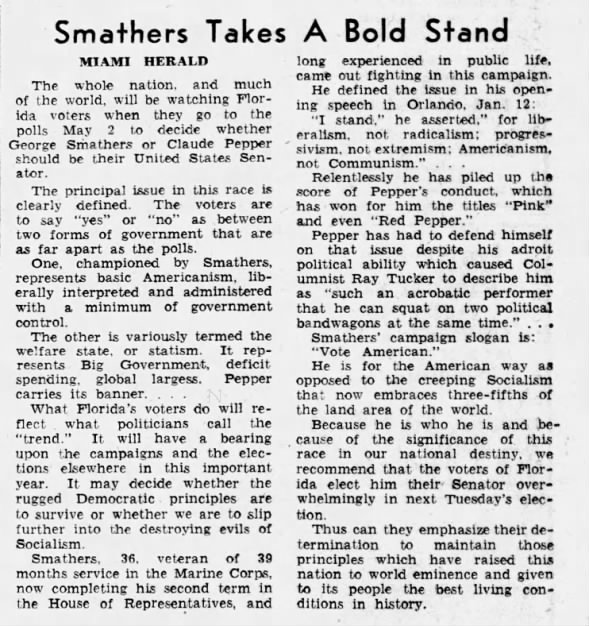
The legend of George Smathers, "Red Pepper" (Matthews, p. 70) and "Vote American"

Sun, Apr 30, 1950 – 27 · The Tampa Tribune (Tampa, Florida, United States of America) · Newspapers.com

The home of Manchester Boddy (Matthews p. 69) is a local attraction in La Canada.


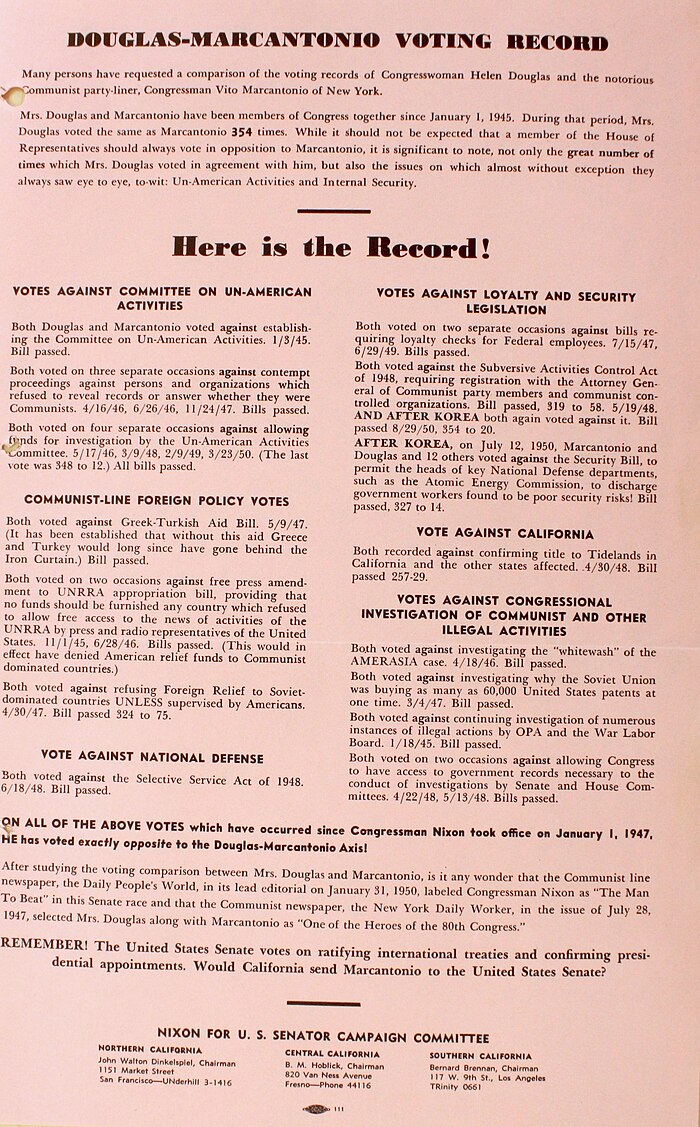
pink piece of paper headed "Douglas-Marcantonio Voting Record"


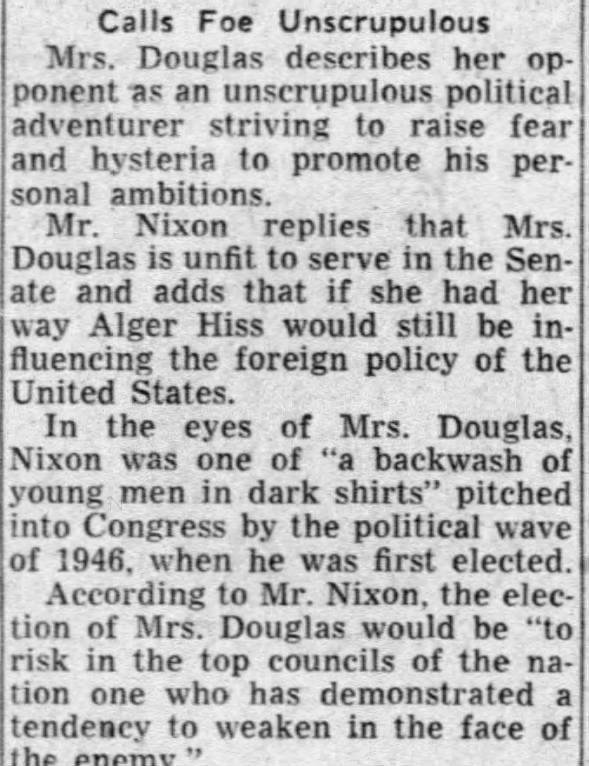
Sat, Nov 4, 1950 – 1 · The Baltimore Sun (Baltimore, Baltimore, Maryland, United States of America) · Newspapers.com

Dean Acheson, left (Yale `15, Harvard Law `18)
Adlai Stevenson, right (Princeton `22, Northwestern Law `26)

Image result for dean acheson


THE 1952 CONVENTION: MAKE A MENTAL NOTE ABOUT EARL WARREN

Matthews pp. 82-86 - Checkers (start about 16:00)
The mention of the dog was just a humorous aside in a shrewd political speech.  


Monday, September 5, 2022

Nixon and Kennedy in Washington

  FOR THURSDAY, READ MATTHEWS THROUGH CH. 7

The GI Generation (born 1901-24)-- as a percentage of House members, senators, governors

  • 1945 16%
  • 1947 26%
  • 1951 40%
  • 1953 48%
  • 1961 69%
  • 1969 72%
They are all gone from political life.  The oldest member of Congress is Senator Feinstein, born in 1933.  The oldest governor is Alabama's Kay Ivey, born in 1944. 

Every president from JFK through Bush 41 was in uniform during WWII:
  • JFK - Navy, South Pacific
  • LBJ - Navy, South Pacific (briefly)
  • Nixon - Navy, South Pacific
  • Ford - Navy, South Pacific
  • Carter -- naval cadet
  • Reagan - Army (made training films)
  • Bush - Navy, South Pacific
JFK's first book (senior thesis at Harvard):

Image result for "why england slept"
JFK's wartime experience got the Hollywood treatment:


About the peace thing, he said, "I told them that I know it is awfully hard to keep this in perspective. I told them that"--he seemed to grope for a date--"in 1939 I thought Neville Chamberlain was the greatest man living and Winston Churchill was a madman. It was not until years later that I realized that Neville Chamberlain was a good man, but Winston Churchill was right." Then he sort of shrugged his shoulders and said, "I doubt if that got over."
Communism and the Cold War.  

The "PAC" issue in 1946.  Nixon comes away thinking he is a great debater.

Nixon's victory was NOT an unusual event in 1946.  Sixty-two incumbent House Democrats lost, compared with only seven Republicans.


Oil money in 1946

The Hiss Case

Evan Thomas writes:
At a later session, as Nixon and Hiss were sparring over some point of law, Hiss huffily declared, “I am familiar with the law. I attended Harvard Law School. I believe yours was Whittier?” Robert Stripling, the committee's chief investigator, observed that “Nixon turned red and blue and red again. You could see the hackles on his back practically pushing his coat up."
Hiss was indeed a spy.

Whittaker Chambers, Witness:
Those were the forces - Thomas Murphy, Richard Nixon, the men of the F.B.I. - who, together with the two grand juries and Tom Donegan and the two trial juries, finally won the Hiss Case for the nation. It is important to look hard at them for a moment. . . . For the contrast between them and the glittering Hiss forces is about the same as between them and the glittering French chivalry and the somewhat tattered English bowmen who won at Agincourt. The inclusive fact about them is that, in contrast to the pro-Hiss rally, most of them, regardless of what they had made of themselves, came from the wrong side of the railroad tracks. . . .

No feature of the Hiss Case is more obvious, or more troubling as history, than the jagged fissure, which it did not so much open as reveal, between the plain men and women of the nation, and those who affected to act, think and speak for them.
Nixon did not play a prominent role in the HUAC investigation of Hollywood, but his presence on the committee left bad memories among people in the industry.


October 1, 1949:  Mao wins in China.  MAKE A MENTAL NOTE OF THE CHINA LOBBY

Catholic opposition

June 25, 1950: Korean War starts


A friend of the family

"It was hard to find a more committed Cold Warrior in either party than the thirty-four-year-old from Massachusetts"(Matthews, p. 75).


Helen Gahagan Douglas

The 1950 race:  a check from Joe Kennedy (Matthews, ch. 70).


Vito Marcantonio


Thursday, September 1, 2022

Nixon in Historical Context

For Tuesday, read Matthews, ch. 1-5

Nixon and Trump

Nixon and Biden

The Nixon Puzzles

  • In just six years, from 1946 to 1952, he went from a not-very-successful small-town lawyer to vice president.
  • Hoff (p. 3) says he was "aprincipled" -- meaning?
  • Schoen (pp. 12-15) -- a moderate polarizer?
  • His relationship with JFK was "mysterious and inexplicable," said Haldeman (quoted in Matthews, p. 20)

Shortly after resigning, he told former aide Ken Clawson:

What starts the process, really are laughs and slights and snubs when you are a kid. Sometimes it's because you're poor or Irish or Jewish or Catholic or ugly or simply that you are skinny. 
But if you are reasonably intelligent and if your anger is deep enough and strong enough, you learn that you can change those attitudes by excellence, personal gut performance while those who have everything are sitting on their fat butts.
 You were a good athlete. But I was not and that was the very reason that I tried and tried and tried. To get the discipline for myself and to show the others that here was a guy who could dish it out and take it. Mostly, I took it.
"But once you learn that you've got to work harder than everybody else it becomes a way of life as you move out of the alley and on your way. In your own mind you have nothing to lose so you take plenty of chances and if you do your homework many of them pay off. It is then you understand, for the first time, that you have the advantage because your competitors can't risk what they have already.

Early Life

Born January 9, 1913, in Yorba Linda in a house that his father built from a kit.

School 
Nixon at Whittier High 
  • Nixon went to Fullerton Union High, living with an aunt during sophomore year. He had greater success as a debater.
  • At the start of his junior year in September 1928, transferred to Whittier High School. He lost his bid for student body president. He often rose at 4 a.m., to drive the family truck into Los Angeles and purchase vegetables at the market. 
  • Two of his brothers died.  Video at 28:00
College and law school education
  • Nixon was offered a tuition grant to attend Harvard, but Harold's illness and his mother's absence meant Richard had to work at the store. He attended Whittier College.  
  • Nixon played football, mostly as a tackling dummy.
  • Nixon did drama and debate.
  •  Nixon was snubbed by the only fraternity, the Franklins; many of the Franklins were from prominent families, but Nixon was not. He responded by helping to found a new society, the Orthogonian Society.

  • After graduating summa cum laude with a BA degree in history  in 1934, Nixon received a full scholarship to attend Duke Law. he graduated third in his class in June 1937.

  Overview and Politics

  Garry Wills interviewed him for Nixon Agonistes (1969):
“You asked me if Teddy Roosevelt is my hero. Not in the sense that Wilson is. I think he was our greatest President of this century. You'll notice, too, that he was the best-educated."
Nixon recommended Wilson's essay "Leaders of Men."
The competent leader of men cares little for the interior niceties of other people’s characters: he cares much-everything for the external uses to which they may be put. His will seeks the lines of least resistance; but the whole question with him is a question of the application of force. There are men to be moved: how shall he move them? He supplies the power; others supply only the materials upon which that power operates. The power will fail if it be misapplied; it will be misapplied if it be not suitable both in kind and method to the nature of the materials upon which it is spent; but that nature is, after all, only its means. It is the power which dictates, dominates: the materials yield. Men are as clay in the hands of the consummate leader.

Tuesday, August 30, 2022

Nixon and Claremont

Nixon and current events:

For Thursday, read: 

  • Hoff, introduction
  • Schoen, introduction
  • Matthews, introduction 

Wingert & Bewley became Bewley, Lassleben & Miller 


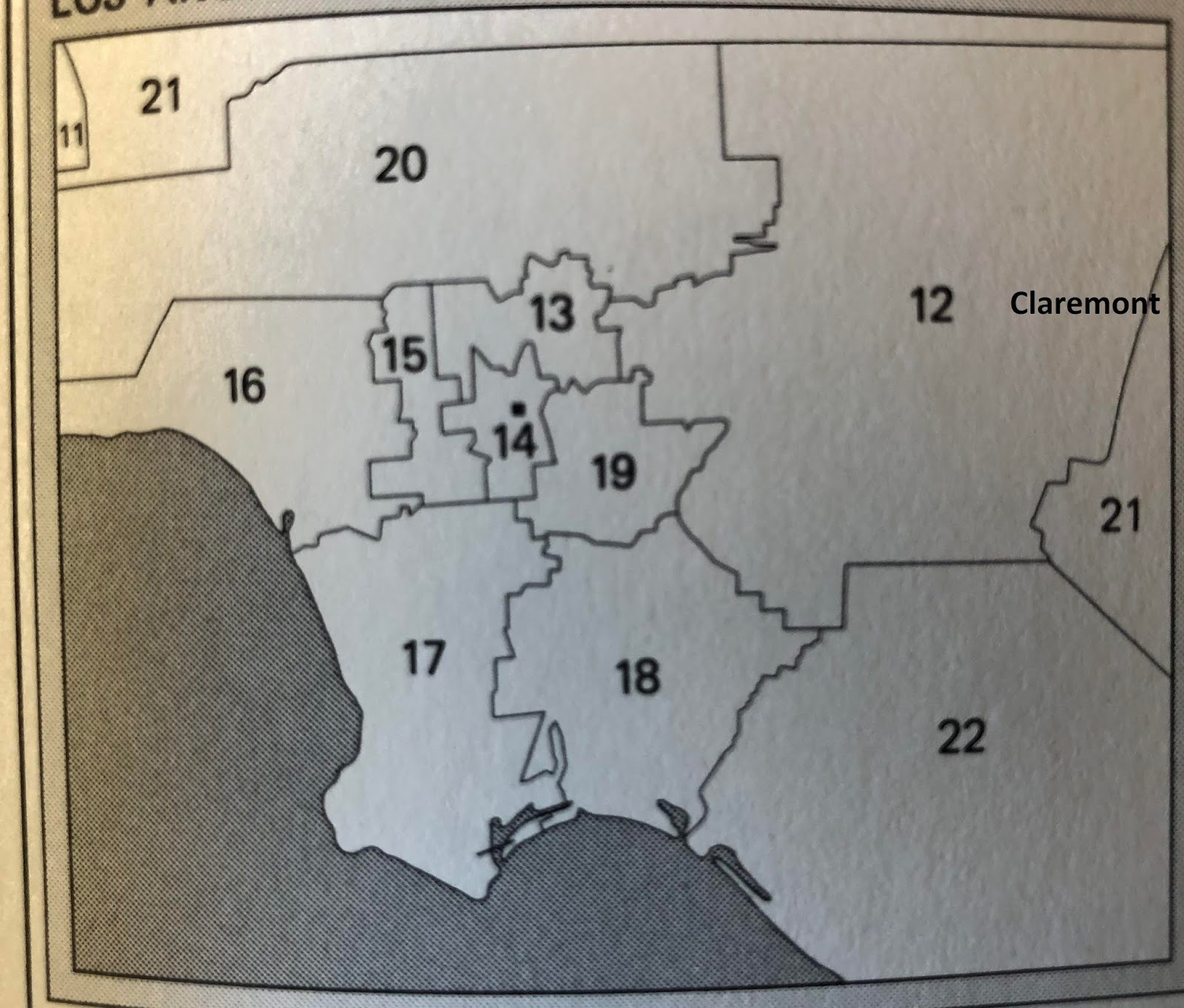
In Richard Milhous Nixon, Roger Morris describes the district:
The district began in the east among the quiet settlements strung out beneath the San Gabriels at the northern rim of the basin. Claremont with its vineyards, shaded campuses, and midwestern Victorian homes gave way to the tiny citrus towns of La Verne, Glendora, and San Dimas; farther west, Monrovia, Duarte, and Arcadia nestled in the foothills...In its own rich valley to the south lay the business and residential center of Pomona ... Across the valley floor lay the old fiftieth Assembly district, more white-walled and red-tiled homes in Covina and West Covina ... El Monte, a larger town of 36,000, was nearby with its walnuts, still more oranges, and one of the basin's famous lion farms.  And still farther south ... the district took in the slopes and valleys of Whittier and La Habra.


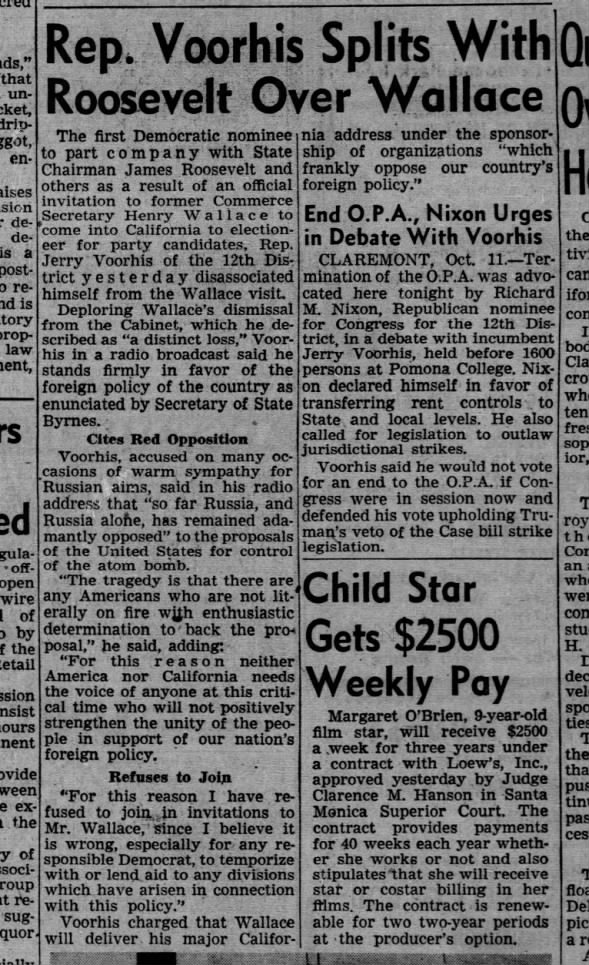
Jerry Voorhis

  A young man wearing a suit and tie turns profile to the camera, holding a pipe in his hand.

Roy P. Crocker was chair of Lincoln Savings and Loan and a benefactor of CMC. In a memo for a 1975 oral history, he recalled:
Herman L. Perry, Manager of the Bank of America branch in Whittier, knew about Richard M. Nixon's ability as a debater when he was in Whittier College. He telephoned to Nixon, who was in Baltimore renegotiating airplane contracts for the U. S. Navy Group, and suggested that he return to California and appear as a prospective candidate before the Fact Finding Committee, consisting of leading Republicans in the 12th Congressional District. Nixon appeared at about the second meeting of the committee and made an instantaneous favorable impression and he was selected as the candidate over seven other aspirants. Nixon received all but eight votes on the final ballot and then the vote was made unanimous. There were three assembly districts in the 12th Congressional District and three members from each district were selected to manage the primary campaign. I was one of the nine members chosen and I was elected Chairman of the Campaign. Roy Day was chosen by the committee as the Campaign Manager.

Business card for Richard Nixon as a congressional candidate, showing an address and phone numbers in Whittier


an election handout urging Nixon's election


debatedebate Sat, Oct 12, 1946 – 9 · The Los Angeles Times (Los Angeles, Los Angeles, California, United States of America) · Newspapers.com


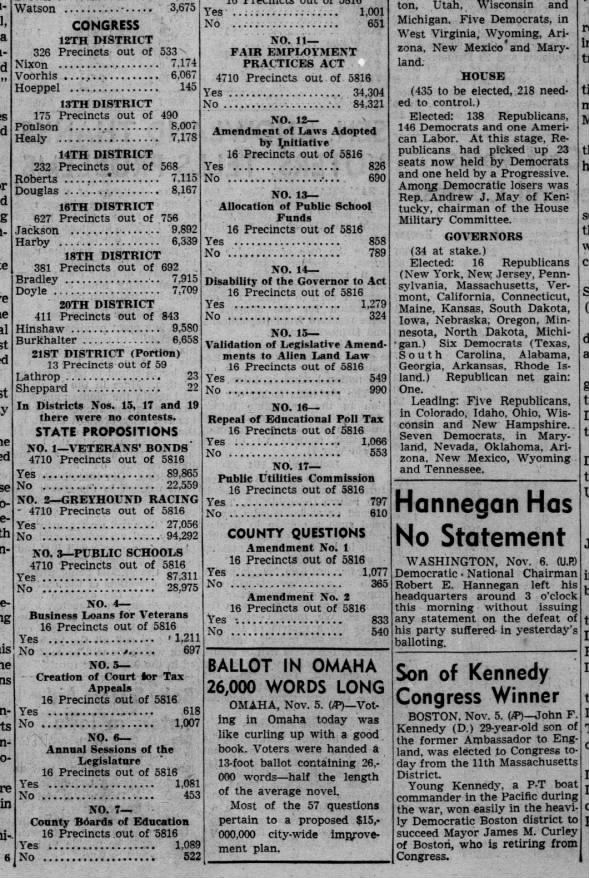
Wed, Nov 6, 1946 – 1 · The Los Angeles Times (Los Angeles, Los Angeles, California, United States of America) · Newspapers.com

Al Felzenberg:
Nixon's internationalism, anti-communism, and interest in foreign affairs, for example, were evident very early. In his first months in Congress, Nixon took his first trip to Europe as part of a fact-finding tour of postwar conditions assembled by Massachusetts representative (and future secretary of state) Christian Herter. Nixon returned prepared to take on his party's isolationist wing in support of the Marshall Plan. In the last address he ever gave, he vividly recalled the impact that trip had on him. (William Elliott, the Harvard professor who advised the Herter Committee and befriended Nixon, would later help launch the career of another young man of promise, Henry Kissinger.)
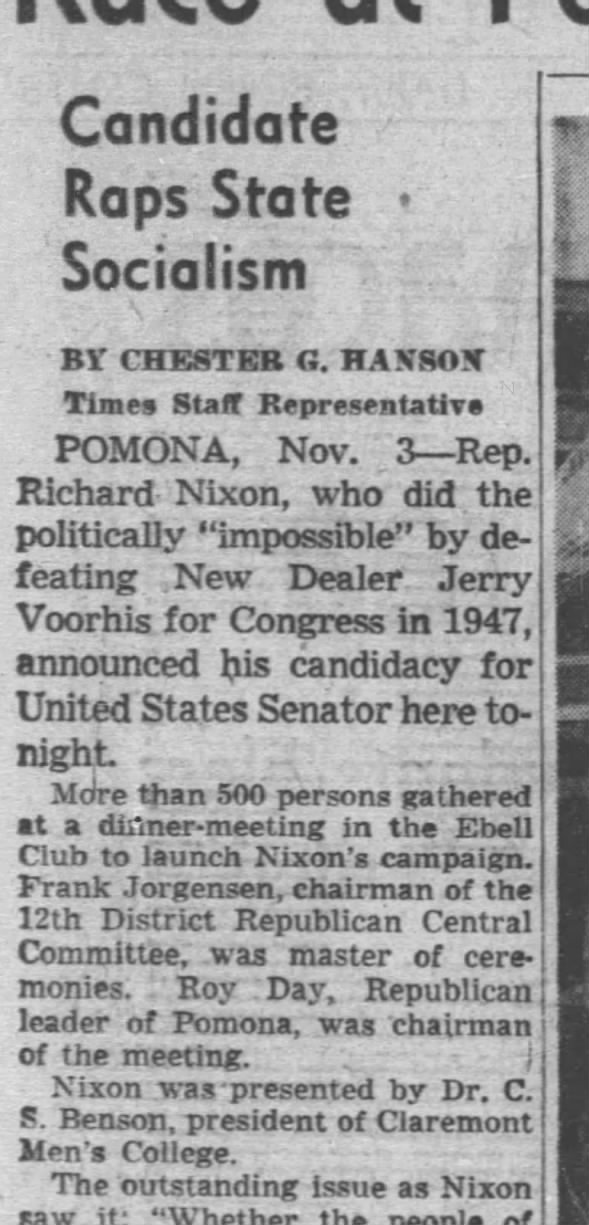
Los Angles Times 11/4/1949

Fri, Nov 4, 1949 – 2 · The Los Angeles Times (Los Angeles, California) · Newspapers.com

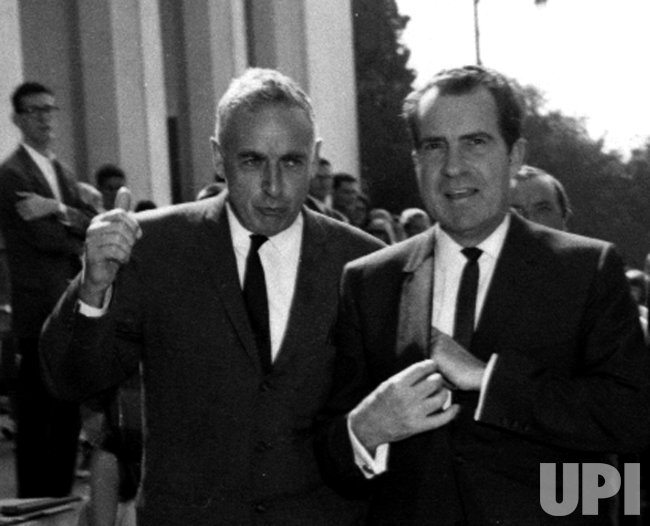
Image result for richard nixon claremont

Thursday, August 25, 2022

Fall 2022 Syllabus

Cases in American Political Leadership: Richard Nixon

CMC Government 124A  Fall 2022
Tue, Thu 11 AM- 12:15 PM Pacific
Adams Hall, Davidson Lecture Room
ZOOM: https://cmc-its.zoom.us/j/92228697468

J.J. Pitney
Office: Kravis 232    
E-mail:  jpitney@cmc.edu

Office Hours: Mon. Tue. Wed. Thu 1-2 pm and by appointment

General

Richard M. Nixon, the House member representing Claremont, entered the national arena in 1947. He stayed there until his death in 1994. Few political leaders have cast such a long shadow: his 47 years of political activity covered more than one-fifth of U.S. history. During those years, he left his mark on electoral strategy, foreign and domestic policy, economics, governmental institutions and, of course, political ethics. In this course, we shall see how he has shaped American politics through the present day, His career will serve as a case study of how a political leader gains, exercises, and loses power. It will also be a case study in the complexity of political character. He started his career as an anticommunist, and went on to negotiate with the People's Republic of China and the Soviet Union. He made bigoted comments about Jews and African Americans, yet saved Israel in 1973 and extended affirmative action. He called himself a conservative but imposed peacetime wage-price controls, and proposed a guaranteed wage and national health insurance. And he was an intensely private man who bared his soul on audiotape.

Classes

Classes will include lecture and discussion. Finish the readings before class because our discussions will involve those readings. We shall also talk about Nixon's relationship to current affairs, so you must read a good news source such as Politico, Axios, or the New York Times.

Blog

Our class blog is at https://gov124.blogspot.com/. I shall post videos, graphs, news stories, and other material there. We shall use some of this material in class, and you may review the rest at your convenience. You will all receive invitations to post to the blog. (Please let me know if you do not get such an invitation.) I strongly encourage you to use the blog in these ways:
  • To post questions or comments about the readings before we discuss them in class;
  • To follow up on class discussions with additional comments or questions.
  • To post relevant news items or videos.
Grades

The following will make up your course grade:
  • Three 4-page essays: 20% each
  • One 6-page research paper: 25%
  • Class participation, reflections: 15% 
Details
  • The papers will develop your research and writing skills, and test your comprehension of class materials In grading your papers, I will take account of the quality of your writing, applying the principles of Strunk and White’s Elements of Style. If you object to this approach, do not take this course, or anything else that I teach.
  • The research paper will give you an opportunity to delve into scholarly and primary sources. Students will make very brief oral presentations on their topics.
  • Class participation will hone your ability to think on your feet, as I shall call on students at random. If you often miss class or fail to prepare, your grade will suffer. I shall use the cold calls to judge how well you are keeping up with the material. If you object to this approach, do not take this course. I also expect you to post relevant material to the blog.
  • Before each week's Thursday class, email me your reactions to that week's readings.  In these emails, you may describe the overall theme of the readings, identify important information or concepts that you have learned, or raise questions or criticisms. These emails should be short -- 250 words maximum -- but they will provide me with a good sense of what you are getting out of the course readings.
  • In addition to the required readings (below), I may also give you emails and web links covering current events and basic factual information.
  • Check due dates. Plan your schedule accordingly. Do not plan on extensions.
Other points
  • As a courtesy to your fellow students, please arrive promptly and refrain from eating in class.
  • This class welcomes both debate and respect.  On viewpoint diversity: https://heterodoxacademy.org/library/advice-on-syllabus-language/
  • Plagiarism is not a victimless offense, because it hurts fellow students. Please study our Statement of Academic Integrity, which reads in part: "The faculty of Claremont McKenna College is firmly committed to upholding the highest standards of academic integrity. Each faculty member has the responsibility to report cases of academic dishonesty to the Academic Standards Committee, which has the duty of dealing with cases of alleged academic dishonesty."
  • Your experience in this class is important to me, and I have a particular interest in disability. If you have set up accommodations with Accessibility Services at CMC, please tell me so we can discuss your needs in this course. You can start by forwarding me your accommodation letter. If you have not yet established accommodations but have a health condition or permanent disability (e.g., mental health, attention-related, learning, vision, hearing, physical or health), please get in touch with Assistant Dean for Academic Success and Accessibility Services, Maude Nazaire, at Accessibilityservices@cmc.edu to ask questions or begin the process. You may find general information and accommodations request information at the CMC Accessibility Services website.
.Books for Purchase
  • Joan Hoff, Nixon Reconsidered (New York: Basic Books, 1994).
  • Christopher Matthews, Kennedy and Nixon: The Rivalry That Shaped Postwar America (New York: Touchstone, 1997).
  • Michael Nelson, Resilient America: Electing Nixon in 1968, Channeling Dissent, and Dividing Government (Lawrence, Kansas: University Press of Kansas, 2014).
  • Douglas E. Schoen, The Nixon Effect: How Richard Nixon's Presidency Fundamentally Changed American Politics (New York: Encounter, 2016)
Schedule (subject to change, with notice)

Aug 30, Sept 1: Introduction


“I saw both greatness and meanness in Nixon in such bewildering combination that, years later, peering out of a hotel window at the White House which I had been forced to leave, I muttered out loud: ‘Nixon was the weirdest man ever to live in the White House.’" -- H.R. Haldeman
  • Hoff, introduction
  • Schoen, introduction
  • Matthews, introduction 
Sept 6, 8: Young Men in a Hurry

"To test him, Day invited students from all-female Scripps College to a coffee. They sat in a circle on the floor, interrogating Nixon, who responded, to Day's great relief, by taking each pointed question, complimenting the questioner, and tugging the women toward his position without being confrontational." -- John A. Farrell, Richard Nixon: The Life.
  • Matthews, ch. 1-7
Sept 13, 15: Kennedy v. Nixon

"In our campaigns, no matter how hard-fought they may be, no matter how close the election may turn out to be, those who lose accept the verdict, and support those who win. And I would like to add that, having served now in Government for 14 years, a period which began in the House just 14 years ago, almost to the day, which continued with 2 years in the Senate and 8 years as Vice President, as I complete that 14-year period it is indeed a very great honor to me to extend to my colleagues in the House and Senate on both sides of the aisle who have been elected; to extend to John F. Kennedy and Lyndon Johnson, who have been elected President and Vice President of the United States, my heartfelt best wishes, as all of you work in a cause that is bigger than any man's ambition, greater than any party. It is the cause of freedom, of justice, and peace for all mankind.: -- Vice President Nixon, presiding over the electoral vote count on January 6, 1961
  • Matthews, ch. 8-14
FIRST ESSAY ASSIGNED SEPT 13, DUE SEPT 30.  READ STRUNK & WHITE FIRST.

SEPTEMBER 15 CLASS WILL BE ASYNCHRONOUS VIA ZOOM.

Sept 20, 22: Wilderness

"You won't have Nixon to kick around any more, because, gentlemen, this is my last press conference..." -- Richard Nixon, November 7, 1962
  • Matthews, 15-19
  • Nelson, ch. 1-2
Sept 27, 29: Comeback

"Nixon hates psychiatrists. He's got this thing, apparently. They make him very very nervous. You should have heard him on the phone when I told him I had one on the panel. Did you hear him? If I've ever heard a guy's voice turn white, that was it." -- Roger Ailes, organizing a TV panel for the 1968 campaign, quoted in The Selling of the President 1968.
  • Nelson, ch 3-5
Oct 4, 6: The 1968 Election

"Or some of our folks, including some of the old China Lobby, are going to the [South] Vietnamese embassy and saying, `Please notify the President [Thieu] that if he’ll hold out till November the 2nd they could get a better deal.' Now, I’m reading their hand, Everett. I don’t want to get this in the campaign. And they oughtn’t to be doing this. This is treason." -- President Lyndon Johnson to Senate GOP Leader Everett Dirksen, November 2, 1968
  • Nelson, ch. 6-8
  • Matthews. ch. 20
SECOND ESSAY ASSIGNED OCT 6, DUE OCT 21.

Oct 11, 13: The Nixon White House

"The Jews have certain traits. The Irish have certain — for example, the Irish can’t drink. What you always have to remember with the Irish is they get mean. Virtually every Irish I’ve known gets mean when he drinks. Particularly the real Irish.” -- Richard Nixon to Chuck Colson, February 13, 1972
OCT 18: FALL BREAK

Oct 20:  The Domestic Presidency

"You know, the truth of the matter is when you look at some of my policies, in a lot of ways Richard Nixon was more liberal than I was. [He] started the E.P.A, you know, started a whole lot of the regulatory state that has helped make our air and water clean." --President Barack Obama, February 3, 2014.
  • Hoff, ch 3-4
  • Schoen, ch. 1
Oct 25, 27: Diplomacy

"Mr. Richardson recalls that the first thing Mr. Nixon said when he entered the Oval Office to resign was a reference to Leonid I. Brezhnev, the Soviet leader. `Brezhnev would never understand it if I let Cox defy my instructions,' the President declared." -- NY Times, 4/12/76
  • Hoff, ch. 5-6.
  • Schoen, ch. 2.
Nov 1, 3: A Wartime President

Richard Nixon: "[B]ecause I look at the tide of history out there—South Vietnam probably can never even survive anyway. I’m just being perfectly candid...."
Henry Kissinger: "...So we’ve got to find some formula that holds the thing together a year or two, after which—after a year, Mr. President, Vietnam will be a backwater. If we settle it, say, this October, by January ’74 no one will give a damn." -- August 3, 1972
  • Hoff, ch. 7-8
Nov 8, 10: CREEP and the Parties

"I want the most, I want the most comprehensive notes on all of those that have tried to do us in. Because they didn't have to do it. They didn't have to do it. I mean, if the thing had been a clo -- uh, they had a very close election everybody on the other side would understand this game. But now they are doing this quite deliberately and they are asking for it and they are going to get it.." -- Richard Nixon to John Dean, September 15, 1972
  • Schoen, ch. 3-6
  • Class presentations
Nov 15, 17:  Downfall I

"In his conduct of the office of President of the United States, Richard M. Nixon, in violation of his constitutional oath faithfully to execute the office of President of the United States and, to the best of his ability, preserve, protect, and defend the Constitution of the United States, and in violation of his consitutional duty to take care that the laws be faithfully executed, has prevented, obstructed, and impeded the administration of justice..." - First article of impeachment, 1974
  • Matthews, ch. 23-27
  • Class presentations
RESEARCH PAPER DUE NOV 18.

Nov 22: Downfall II

"[A]lways remember, others may hate you, but those who hate you don't win unless you hate them, and then you destroy yourself." -- Nixon farewell remarks, August 9, 1974

THIRD ESSAY ASSIGNED NOV 22, DUE DEC 9.

Nov 29, Dec 1: Downfall and Return

'HE'S BACK." --Newsweek cover, May 19, 1986
  • Schoen, ch. 9-10
  • Matthews, epilogue
  • Hoff, conclusion
Dec 6, 8: Legacy

"Two thousand years ago, the poet Sophocles wrote, `One must wait until the evening to see how splendid the day has been.' There is still some time before the sun goes down, but even now, I can look back and say that the day has indeed been splendid."
  • Schoen, ch. 7-8, and afterword