This blog serves my Nixon course (Claremont McKenna College Government 124A) for the fall of 2022
About This Blog
I shall post videos, graphs, news stories, and other material. We shall use some of this material in class, and you may review the rest at your convenience. You will all receive invitations to post to the blog. I encourage you to use the blog in these ways:
·To post questions or comments;
·To follow up on class discussions;
·To post relevant news items or videos.
There are only two major limitations: no coarse language, and no derogatory comments about people at the Claremont Colleges.
J. Edgar Hoover had bugged King aide Stanley Levison.In October 63, RFK approves wiretaps on MLK's home and SCLC office.Hoover has Kennedy files, so he cannot refuse.
Hoover dies on May 5, 1972. L. Patrick Gray succeeds him. Associate Director Mark Felt does not
August 30, 1972: President Nixon announces that John Dean has completed an investigation into the Watergate buggings and that no one from the White House is involved.
September 15, 1972: Bernard Barker, Virgilio Gonzalez, E. Howard Hunt, G. Gordon Liddy, Eugenio Martinez, James W. McCord, Jr., and Frank Sturgis are indicted for their roles in the June break‑in.
January 8, 1973 Watergate break‑in trial opens. Hunt pleads guilty (January 11); Barker, Sturgis, Martinez, and Gonzalez plead guilty (January 15); Liddy and McCord are convicted on all counts of break‑in indictment (January 30).
February 7, 1973 U.S. Senate creates Select Committee on Presidential Campaign Activities.
March 17, 1973: Watergate burglar McCord writes a letter to Judge John Sirica, claiming that some of his testimony was perjured under pressure and that the burglary was not a CIA operation, but had involved other government officials, thereby leading the investigation to the White House.
April 17, 1973 President Nixon announces that members of the White House staff will appear before the Senate Committee and promises major new developments in the investigation and real progress toward finding the truth.
April 23, 1973 White House issues a statement denying President Nixon had prior knowledge of Watergate affair.
April 30, 1973 White House staff members H. R. Haldeman, John D. Ehrlichman, and John Dean resign. Nixon then gets drunk, calls Haldeman.
May 17, 1973 Senate Committee begins public hearings.
May 25, 1973 Archibald Cox sworn in as Special Prosecutor.
July 7, 1973 President Nixon informs Senate Committee that he will not appear to testify nor grant access to Presidential files.
As president, Nixon did, in fact, do much for the Right—but not in the way that conservatives would have expected. Moving leftward domestically, economically, and internationally, he first frustrated, then alienated, and finally galvanized American conservatives to action. Much of the political organizing and grassroots activism that forged today's Right got started during the Nixon years and the Ford and Carter years that followed.
Steering too far in the direction of independence risks provoking presidential disapproval. In fact, it was the displeasure of one White House aide with the think tanks of the time that led to creation of the Heritage Foundation in the first place. In 1970, a small delegation of conservatives met with the Nixon White House staffer Lyn Nofziger to discuss how to get research support for conservative ideas in Congress. When one of the participants mentioned the American Enterprise Institute, Nofziger had a visceral reaction. Paul Weyrich, who was at the meeting, recalled that Nofziger said: “‘AEI? AEI—I'll tell you about AEI.’ And he got up, walked over to a bookcase, took a study off the shelf and literally blew the dust—I mean, you saw this cloud of dust. And he said, ‘That's what they're good for. They're good for libraries.’” The beer mogul Joseph Coors, who was also at the meeting, decided as a result to back the initiative that became the Heritage Foundation.
.It is time now to rethink and reorder the institutions of this country so that everyone—women, blacks, Spanish-speaking, Puerto Ricans, Indians, the young and the old—can participate in the decision-making process inherent in the democratic heritage to which we aspire. We must restructure the social, political and economic relationships throughout the entire society in order to ensure the equitable distribution of wealth and power.
The Democratic Party in 1972 is committed to resuming the march toward equality; to enforcing the laws supporting court decisions and enacting new legal rights as necessary, to assuring every American true opportunity, to bringing about a more equal distribution of power, income and wealth and equal and uniform enforcement in all states and territories of civil rights statutes and acts.
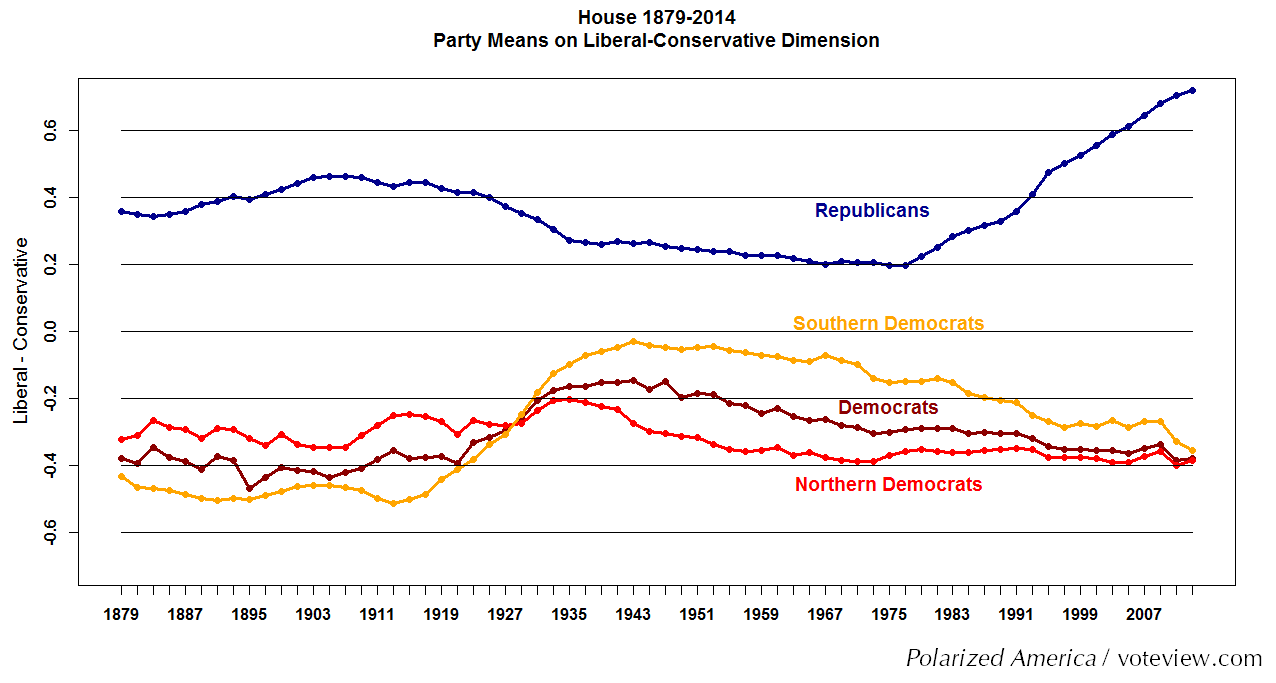
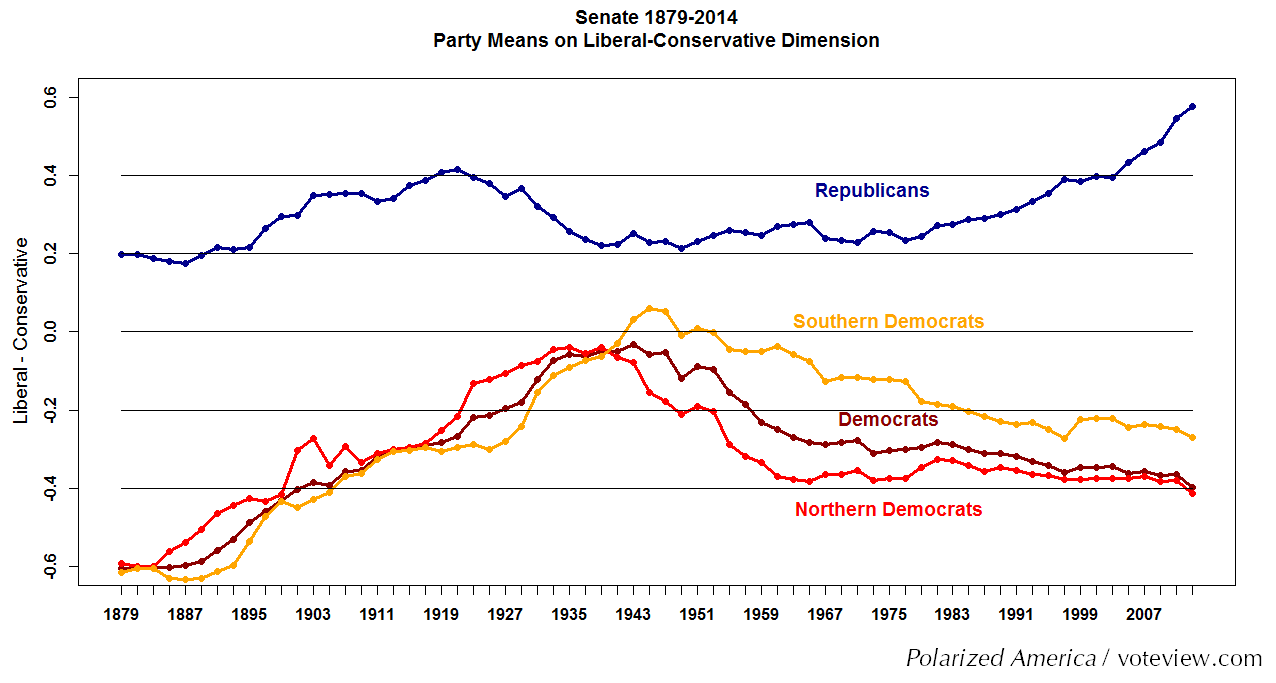
The 1970 midterm: Senate elections (last column) are different
Pat Buchanan (Schoen 92):
What the Left never understood, or would never accept, is that Nixon brought the South into the Republican column not because he shared their views on segregation or civil rights. He did not. What he shared was the South’s contempt for a liberal press and hypocritical Democratic Party that had coexisted happily with Dixiecrats for a century but got religion when conservative Republicans began to steal the South away from them.
The Goldwater-Nixon party in which I enlisted was not a segregationist party but a conservative party. Virtually every segregationist in the eleven states of the old Confederacy, and every Klansman from 1865 to 1965, belonged to the party of Woodrow Wilson, Franklin Roosevelt, and Harry Truman.
As president, Nixon did, in fact, do much for the Right—but not in the way that conservatives would have expected. Moving leftward domestically, economically, and internationally, he first frustrated, then alienated, and finally galvanized American conservatives to action. Much of the political organizing and grassroots activism that forged today's Right got started during the Nixon years and the Ford and Carter years that followed.
See above: inflation was not really bad in 1971. Wage-Price Controls (Schoen 45-47): A Rare Admission of Error
What did America reap from its brief fling with economic controls? The August 15, 1971 decision to impose them was politically necessary and immensely popular in the short run. But in the long run I believe that it was wrong. The piper must always be paid, and there was an unquestionably high price for tampering with the orthodox economic mechanisms.
It's a part of my attitude towards governments involved in the economy, [one that] goes back to having been involved in wage/price controls during the Nixon years. I was the assistant director of the Cost of Living Council, supervising 3,000 agents trying to enforce wage/price controls. I always remember a debate we had. This was in 1972 during the reelection campaign, the Nixon administration, when the public was convinced that food prices were going up, so the political debate was whether or not we should re-impose a freeze on food prices. But in reality, if you looked at the consumer price index, the food component, it hadn't budged in six months. There had been absolutely no increase in food prices whatsoever. But we had a meeting in the Cabinet room where we argued about whether or not we should put controls back on food prices. And at one point President Nixon spoke up and quoted... "Sometimes in order to be a statesman you have to be a politician for a while. And when the people see an imaginary river out there, the politician doesn't say, 'There's no river there'; he builds an imaginary bridge over the imaginary river. Therefore we ought to control food prices." That struck me. It captured a lot of the dangers, even though best intentions can get you in trouble with respect to too much government involvement in the community.... But especially it's dangerous when you get to the point where you're working off misperceptions and trying to build a government policy that's not based on fact and on reality and on truth, but rather on the myth that somehow there's an imaginary river there. You don't say to the public, "There's no river there"; you say, "Okay, we'll put an imaginary bridge over your imaginary river.
A. Based on the C.I.A.'s record of accuracy in their reports, I would take all of that with a grain of a salt. They didn't even predict that he was going to win this time. They didn't predict what was going to happen in Cambodia. They didn't predict there was going to be the Yom Kippur War. As far as the C.I.A. was concerned, at that point, and now I understand it is being improved, and I trust it will be under the new leadership, at that point its intelligence estimates were not very good on Latin America. I also go back to the point that in terms of what we really have here in Chile. I remember months before Allende came to power in 1970. An Italian businessman came to call on me in the Oval Office and he said, “If Allende should win the election in Chile, and then you have Castro in Cuba, what you will in effect have in Latin America is a red sandwich, and eventually it will all be red.”
70% --To avoid a humiliating US defeat (to our reputation as a guarantor). 20%--To keep SVN (and then adjacent) territory from Chinese hands. 10%--To permit the people of SVN to enjoy a better, freer way of life.
1967 Anti‑war demonstrations begin in the USA.
1968 Tet offensive inflicts heavy casualties on US army. LBJ drops out of reelection race.
1968 Nixon elected President/ The Chennault Affair
1969 US fighting troops reach top strength. Peace talks begin.
1969 - President Nixon orders a "random selection" lottery system for selecting men to serve in the war in Vietnam, changing the previous system of drafting according to age.
In this assignment, you will write a research paper on any Nixon-related topic of your choice. Here are some options, but you are free to choose another, as long as it is Nixon-centric. During the first two full weeks of April, you will each make a 5-minute Power-Point-free class presentation on your topic. (You may post graphs or video clips on the class blog.)
Explain a major Nixon decision in foreign policy or national security. What military, diplomatic and political considerations went into his choice? And what do we know now that was not public knowledge at the time?
Choose any major figure in Nixon's life (not counting anyone you may have written about in the second assignment). How did this person influence Nixon's life and career? Did this person serve as friend, foe, mentor, foil, punching bag -- or some combination thereof? What did Nixon gain or lose as a result of the relationship? In your answer, consider the historical circumstances that allowed this person to have this influence.
Instructions:
Essays should be typed (12-point), double-spaced, and no more than six pages long. I will not read past the sixth page. As always, please submit papers to the Sakai dropbox as Word documents, not pdfs.
Document your claims. Do not write from the top of your head. Wherever possible, rely on primary sources and scholarly works.
Cite your sources with endnotes in Chicago/Turabian style. Endnote pages do not count against the page limit.