About This Blog

I shall post videos, graphs, news stories, and other material. We shall use some of this material in class, and you may review the rest at your convenience. You will all receive invitations to post to the blog. I encourage you to use the blog in these ways:

· To post questions or comments;

· To follow up on class discussions;

· To post relevant news items or videos.

There are only two major limitations: no coarse language, and no derogatory comments about people at the Claremont Colleges.

Statement on viewpoint diversity: https://heterodoxacademy.org/teaching-heterodoxy-syllabus-language/


Syllabus: https://gov124.blogspot.com/2022/08/cases-in-american-political-leadership.html

Thursday, February 28, 2019

RIP, Ed Nixon

From the Nixon Foundation:

February 27, 2019
Edward Nixon, the youngest and last surviving brother of President Richard Nixon, died today at a skilled nursing facility in Bothell, Washington. He was 88 years old.
...
Mr. Nixon worked on his brother’s successful presidential campaigns in 1968 and 1972 and served as Co-Chairman of the Nixon re-election committee in 1972.
“For some people, meeting me is one degree of separation from meeting my famous brother,” Ed Nixon wrote in 2009. “Dick was more than a brother. Because we never shared a boyhood, he assumed the role of assistant father and mentor. At the time of my birth, he was seventeen and getting ready to start college. But he realized he could be an important influence in my life, and he took his self-imposed responsibility seriously, always listening to his kid brother.”
“I considered Dick to be outgoing with his ears — not with his mouth. Through thought-provoking questions, he encouraged me to learn and solve problems. More than anyone else in the family, he could stand back from a contentious situation and give impartial and convincing advice,” he wrote.
Ed Nixon was an original member of the Board of Directors of the Richard Nixon Foundation.
A career geologist and expert on global energy use, Mr. Nixon spent six decades pursuing the responsible use of natural resources around the globe. Throughout his career, he served as an advisor to several cutting-edge companies in the field of Earth science.
Edward Calvert Nixon was born on May 3, 1930, in Whittier, California. He was the fifth and youngest child of Frank and Hannah Nixon, and named Edward after an English King, as was Nixon family tradition.
“Frank and Hannah Nixon raised five sons —Harold, Dick, Don, Arthur, and me— in a close-knit family, teaching us the importance of religious faith, traditional values, and a strong work ethic,” Ed Nixon wrote. “Family life revolved around Dad and Mom’s store, the Quaker church, and family gatherings.”

The 1968 Election and Aftermath

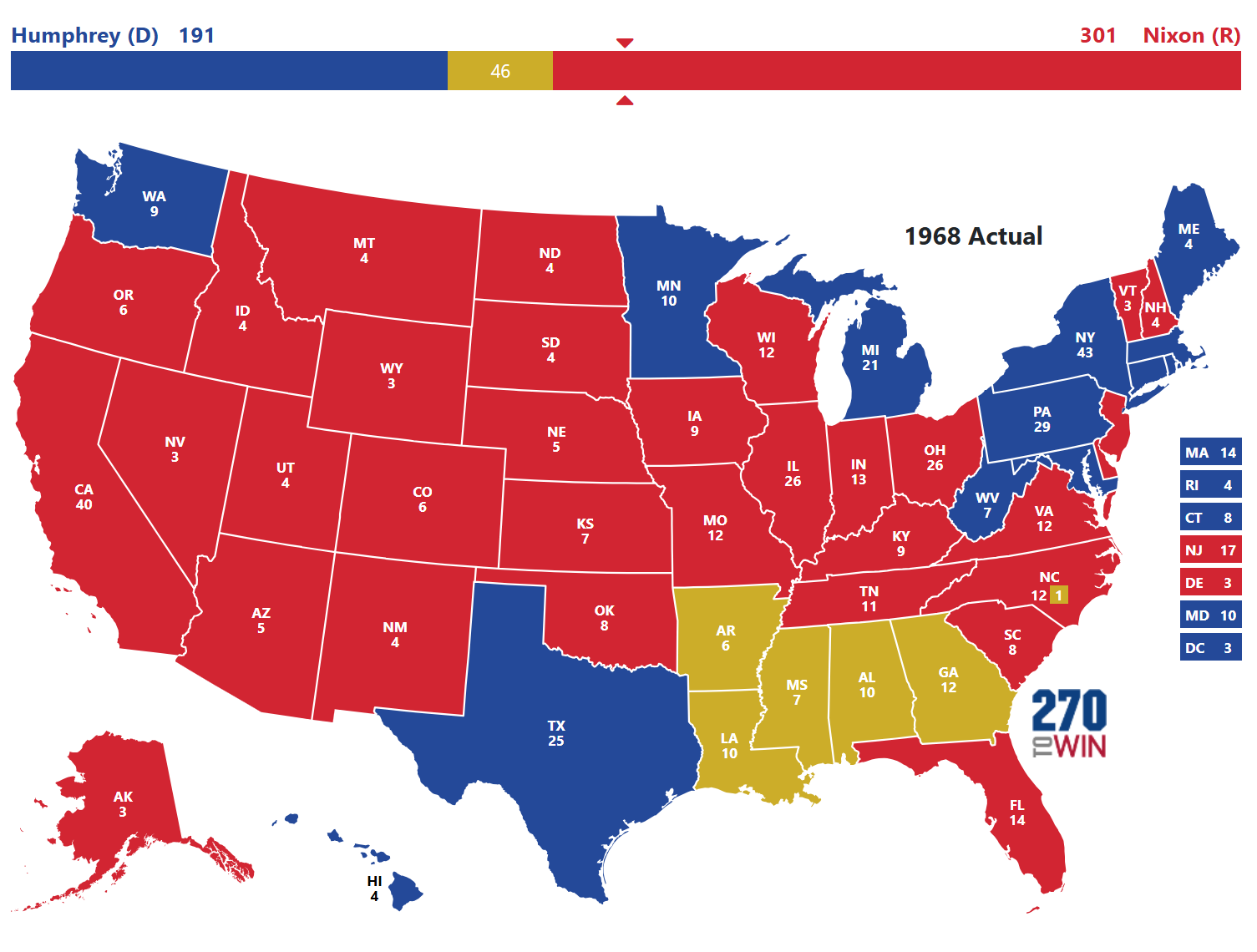
Electoral Map
Popular vote by state
Alternative scenarios
Vote by groups (enlarged view)
The HOUSE VOTED TO ABOLISH THE ELECTORAL COLLEGE
Nixon supported the idea.  Repeat, Nixon supported it.
No one subject more profoundly involves the issue of popular sovereignty than the method of electing the President. For almost two centuries the system of the Electoral College has somehow worked, albeit just barely at times, and at other times even doubtfully. Every four years the American democracy places a large, unacceptable, and unnecessary wager that it will work one more time, that somehow an institution that never in any event functioned the way the framers of the Constitution anticipated, will somehow confer the Presidency on that candidate who obtains the largest number of votes. The Electoral College need not do so. Indeed on occasion it has not done so. But far more importantly--whatever the popular vote--it need not confer the Presidency on any candidate, if none has a majority of the electoral vote.
Our ability to change this system in time for the 1972 elections is a touchstone of the impulse to reform in America today. It will be the measure of our ability to avert calamity by anticipating it.
As I stated in my October 1969 message, I originally favored other methods of reforming the electoral college system, but the passage by the House of a direct popular election plan indicated that this thoroughly acceptable reform could be achieved, and I accordingly supported it. Unfortunately, the Senate has not completed action. Time is running out. But it is still possible to pass the measure and to amend the Constitution in time for the 1972 elections.


Image result for 1968 electoral map


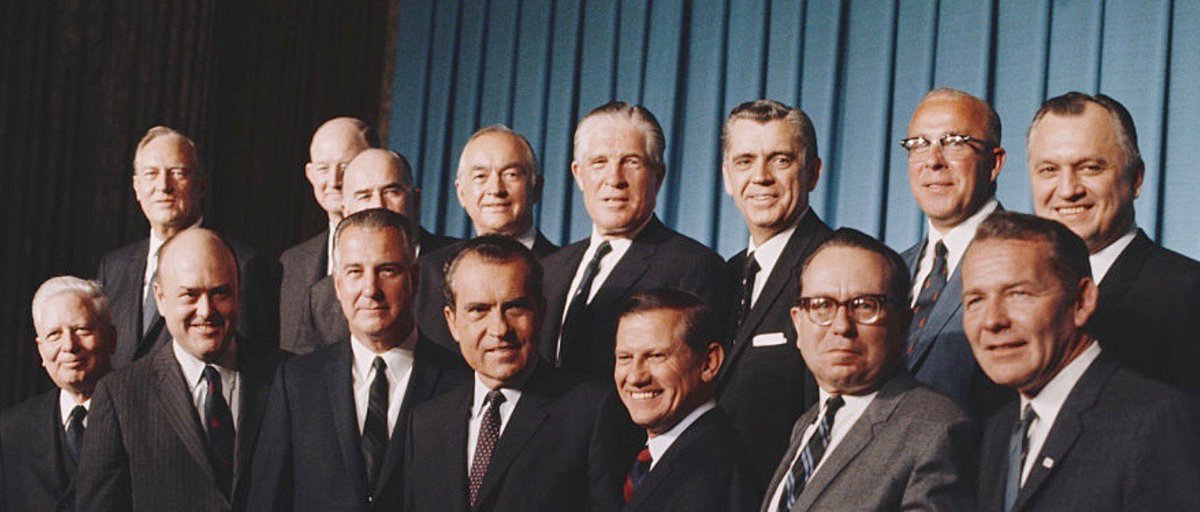
Nixon cabinet

Notice something about the demographics?

Image result for nixon cabinet 1968

Last month was the 50th anniversary of Nixon inaugural

The inaugural address:

Second Assignment

Choose one:
  • Pick a major Nixon legislative proposal (e.g., FAP, the 1971 or 1974 health care bill). Explain its origins and fate. Why did Nixon support it? What happened to it? Did it lay the foundation for future legislation?
  • Pick any member of the Nixon White House staff (e.g., Haldeman, Buchanan, Moyhihan). Why did Nixon pick that person? What was his or her job? In the long run, did the relationship work to the benefit or detriment of either person?
  • Compare and contrast Nixon's policies on civil rights both with his public rhetoric and his private comments about African Americans. What accounts for the difference?
  • Write on any relevant topic, subject to my approval.
Sources may include:
The specifications:
  • Essays should be typed (12-point), double-spaced, and no more than four pages long. I will not read past the fourth page.
  • Please submit all papers in this course as Word documents, not pdfs.
  • Cite your sources. Please use endnotes in the format of Chicago Manual of Style. Endnotes do not count against the page limit. Please do not use footnotes, which take up too much page space.
  • Watch your spelling, grammar, diction, and punctuation. Errors will count against you. Return essays to the Sakai dropbox for this class by 11:59 PM, Friday, March 15. Papers will drop one gradepoint for one day’s lateness, a full letter grade after that.

Wednesday, February 27, 2019

Lawyers Testifying Against Their President 44 Years Apart: Similarities Between John Dean and Michael Cohen

Lawyer and Presidential Counsel John Dean on his rise to Nixon's inner circle: “Slowly, steadily,” he wrote, “I would climb toward the moral abyss of the President’s inner circle until I finally fell into it, thinking I had made it to the top just as I began to realize I had actually touched bottom.”

On the bravery John Dean showed in testifying: "Dean’s testimony took days, during which the country was glued to their television sets. Dean connected the dots between a “third-rate burglary,” as President Nixon referred to Watergate, and the activities of CREEP—the sarcastic shorthand for The Committee for the Re-Election of the President. And yet, while the testimony itself was dramatic, it was only the word of one young man against the President of the United States. That is why, when the existence of a taping system in the Oval Office was confirmed, Dean breathed a huge sigh of relief. Dean recalls telling Sam Dash, Chief Counsel for the Senate Watergate Committee, “Sam, do you know what this means, if you can get those conversations?… It would mean my ass is not hanging out there all alone. It means that you can verify my testimony.”


Reasons for testifying : "Cohen is seeking nothing more and nothing less than to rescue his reputation and his place in history. John Dean spent four months in jail before his sentence was changed to time served. Although he was disbarred, he spent the following decades as an investment banker and he also wrote books, many of which were critical of Republican presidents. And these days you will still see him on television, commenting on the many parallels between the cloud around President Trump and the cloud around President Nixon. As awful as going to jail is for anyone, life has not been too bad for John Dean."


Similarities in Restoring Their Image an Honor: "Who knows how much light Cohen will shed on the many suspicious links between Trump and Russia. But one thing we do know is that, like Dean before him, Cohen will be taking the difficult but necessary steps to try and regain some respectability. In fact, Cohen’s lawyer, Lanny Davis has reached out to John Dean for advice. Like Dean, Cohen has credibility issues. Dean was at the inception of the cover up. Cohen has lied to Congress in an effort, now apparently abandoned, to protect the president. He cannot lie again without facing even greater punishment from the federal legal system."


Good quote from Cohen: "I am committed to proving my integrity and ensuring that history will not remember me as the villain of his story.”“This may seem hard to believe but today is one of the most meaningful days of my life. I have been living in a personal and mental incarceration ever since the day that I accepted the offer to work for a real estate mogul whose business acumen that I deeply admired.”
“Recently, the President tweeted a statement calling me ‘weak,’ and he was correct, but for a much different reason than he was implying. It was because time and time again I felt it was my duty to cover up his dirty deeds rather than to listen to my own inner voice and my moral compass.”


Source: https://www.brookings.edu/blog/fixgov/2019/02/26/why-is-michael-cohen-testifying-against-trump-a-key-watergate-figure-may-hold-the-answer/   

Tuesday, February 26, 2019

Fall 1968

Agnew


Nixon spot foreshadows future "decision" ads.


Wallace


Why does Humphrey close?

Gallup


Democrats were still dominant


LeMay (the model for the George C. Scott character in Dr. Strangelove) scares people away from Wallace (Nelson 206)


The Chennault Affair (Nelson 215-216)


Haldeman's notes confirm Nixon's complicity

Agnew and the Saudis

After resigning from office, Agnew disgraced himself further by offering to fight "Zionists" for the Saudi royal family. Start at 13:00

Thursday, February 21, 2019

January-August 1968

Via Smithsonian: January-August 1968
  • January 17:  In his State of the Union Address, LBJ says: "The number of South Vietnamese living in areas under Government protection tonight has grown by more than a million since January of last year."
  • January 23: North Korea seizes the USS Pueblo, claiming the surveillance ship strayed into its waters. One U.S. crewman is killed and 82 others are imprisoned; an 11-month standoff with the United States follows.
  • January 30: North Vietnamese communists launch the Tet Offensive. The assault contradicts the Johnson administration’s claims that the communist forces are weak and the U.S.-backed south is winning the war.  Public opinion continues to turn against the war.
  • February 7: After a battle for the Vietnamese village of Ben Tre, an American officer tells Associated Press reporter Peter Arnett, "It became necessary to destroy the town in order to save it."
  • February 29: The report of the Kerner Commission, appointed by President Lyndon B. Johnson to examine the causes of race riots in American cities in previous years, declares the nation is..."moving toward two societies, one black, one white--seperate and unequal."   Nixon criticizes the commission for its "its tendency to lay the blame for the riots on everyone except the rioters."   MOST AMERICANS AGREE WITH NIXON. 
  • March 5: The government of Czechoslovakia abolishes censorship, underscoring the expansion of freedom during the “Prague Spring” and angering its Communist overlords in the Soviet Union.
  • March 12: Nixon wins 78 percent of the vote in New Hampshire’s GOP primary. Eugene McCarthy, Minnesota’s antiwar senator, takes a shocking 42 percent of the Democratic vote.
  • March 16: New York Senator Robert F. Kennedy enters the race for the Democratic presidential nomination, saying McCarthy’s showing in New Hampshire “has proven how deep are the present divisions within our party and country.” It “is now unmistakably clear that we can change these disastrous, divisive policies only by changing the men who make them."
  • March 31: LBJ announces he is not running for re-election.
  • April 4: Martin Luther King Jr., in Memphis for the sanitation workers’ strike, is fatally shot on the April 4: balcony of the Lorraine Motel. Gunman James Earl Ray, a white supremacist, flees the country. Over the next week, riots in more than 100 cities nationwide leave 39 people dead, more than 2,600 injured and 21,000 arrested.
  • April 11: In the wake of Baltimore riots, Maryland Governor Spiro Agnew summons civil rights leaders...to attack them.
  • April 23: Students take over five buildings on Columbia University’s campus and briefly hold a dean hostage, calling for the university to cut its ties to military research. Before dawn on April 30 administrators call in the police, who respond with about 1,000 officers. More than 700 people are arrested, and 132 students, four faculty and 12 officers are injured.  Protests are unpopular, especially among people who have not been to college (who account for most adults in 1968).
  • May 17: Nine antiwar activists -- including Father Daniel Berrigan and Father Philip Berrigan -- enter a Selective Service office in Catonsville, Maryland, remove nearly 400 files and burn them in the parking lot with homemade napalm. The example of the Catonsville Nine (later convicted of destruction of government property and sentenced to jail terms between 24 and 42 months) spurs some 300 similar raids on draft boards over the next four years.
  • June 4: Robert F. Kennedy, gaining momentum in his presidential campaign, wins the California primary—and is assassinated at the Ambassador Hotel in Los Angeles. Gunman Sirhan Sirhan, a Jordanian citizen of Palestinian descent, is captured at the scene. Now 73, he is serving life in prison. No, Kennedy probably would not have won the nomination if he had lived.
  • August 5-8: Republican National Convention formally nominates Nixon for president.
  • August 20: The Soviet Union invades Czechoslovakia, halting the Prague Spring.
  • August 28: At the Democratic National Convention in Chicago, police and Illinois National Guardsmen go on a rampage, clubbing and tear-gassing hundreds of antiwar demonstrators, news reporters and bystanders, with much of the violence broadcast on national TV. The next day, Vice President Hubert Humphrey, perceived as the heir of Johnson’s war policies, wins the nomination, chooses Senator Edmund Muskie of Maine as his running mate.
Nixon Acceptance


The Democratic Convention


From the Roper Center: "The country certainly appeared to sympathize with the police more than the protestors. In a Gallup poll, 56% approved of the police response to anti-war protestors and 31% did not. In a Harris survey, 66% agreed that Daley was right in the way he used police against the demonstrators, against only 20% who disagreed. Just 14% in the same poll agreed that protestors had had their rights to protest taken away; 66% who did not. "