About This Blog

I shall post videos, graphs, news stories, and other material. We shall use some of this material in class, and you may review the rest at your convenience. You will all receive invitations to post to the blog. I encourage you to use the blog in these ways:

· To post questions or comments;

· To follow up on class discussions;

· To post relevant news items or videos.

There are only two major limitations: no coarse language, and no derogatory comments about people at the Claremont Colleges.

Statement on viewpoint diversity: https://heterodoxacademy.org/teaching-heterodoxy-syllabus-language/


Syllabus: https://gov124.blogspot.com/2022/08/cases-in-american-political-leadership.html

Thursday, March 18, 2021

Setting and Character


 POLICY:  FAMILY ASSISTANCE PLAN, 1969

Warmth

The "Warmth" Memorandum (see also Matthews 282-283)

Nixon's self-awareness


Haunting

"Kennedy's record in foreign policy, as Kissinger points out over and over again, was an utter disaster"

From the Senate Watergate Committee report (Matthews 280-281)

At about 1 a.m. on Saturday, July 19, 1969, Senator Edward Kennedy was involved in an automobile accident at Chappaquiddick, Mass. Later that morning, as news reports of the accident reached the public, Caulfield was directed by Ehrlichman to send Ulasewicz to the scene of the accident as soon as possible. Ulasewicz flew to Boston on the Eastern Airlines shuttle on July 19 and rented a car for the trip to Martha’s Vineyard and Chappaquiddick. Ulasewicz spent 4 days in the area on this first visit and reported back continually to Jack Caulfield in the White House, who passed the information on to Ehrlichman and others as it developed. Ulasewicz spent a good portion of the remaining summer and much of the fall of 1969 at Chappaquiddick trying to dig up politically valuable information from Senator Kennedy’s accident.


Start around 36:00 (audio from 1972)

"FAKE NEWS!" -- 1969 EDITION

"I realize that we have an insurmountable wall of opposition and indifference in the media"

Nixon sics Agnew on the media (START AROUND 4:00)


Evan Thomas provides a flashback:

November 1950, when Rep. Richard Nixon, not yet 40 years old, was elected to the U.S. Senate from California, he received an invitation to a Georgetown dinner party. Every Sunday night, columnist Joe Alsop assembled some of his friends, usually high ranking officials at the CIA and State Department, with a few journalists and politicians thrown in, to dine and drink (copiously) at his house at 2720 Dumbarton Ave. Alsop and his pals wanted to take the measure of young Nixon, who was seen as a rising star in the Republican Party. Alsop’s weekly dinner, known in his circle as “the Sunday Night Supper,” was intimidating to Nixon. Alsop’s friends had gone to Harvard or Yale and carried themselves with assurance. Nixon and his wife, Pat, who had little experience in high society, were visibly uncomfortable as they arrived, recalled Tish Alsop, the wife of Joe’s brother and fellow columnist, Stewart Alsop. It did not help that Nixon’s host forgot his name and introduced him as “Russell Nixon.” At dinner, Ambassador Averell Harriman, a crusty old school diplomat who was slightly deaf, loudly announced, “I will not break bread with that man!”

Retribution against the media 

Wartime President

In Anaheim, RN reacts to the San Jose incident (Matthews 288-289):

And now, I turn to an event related to all this, that occurred in San Jose yesterday. You saw it on your television screens, an incident in which you saw 3,000 people inside listening to the speakers and 1,000 demonstrators outside, demonstrators who shouted epithets, but, in addition to that, who hurled bottles and rocks and bricks, broke windows, damaged the President's car, damaged the buses, injured some of the people in those buses.
It was a violent demonstration. And as that demonstration was concluded, there were those that were trying to indicate what it meant.
I want to give you tonight my judgement as to what that demonstration meant.
I say to you tonight, it is time to draw the line. I do not mean a party line. Because, when I speak of a line, I am referring not just to Republicans or Democrats, I am referring to a line between those who understand this problem and deal with it effectively and those who do not.
You recall what happened at the University of Wisconsin, where someone was killed in a lighted building. Listen to what the Wisconsin State Journal said in an editorial. "It isn't just the radicals that set the bomb in the lighted, occupied building who were guilty. The blood is on the hands of anyone who encouraged them, anyone who talked recklessly of revolution, anyone who has chided with mild disparagement the violence of extremism, while hinting that the cause was right all the time."


Everything Converges (start around 4:50)

Tuesday, March 16, 2021

Early Nixon Administration


Organizational Structure

RN had a pretty darn good record on Native Americans.

RN and the Environment:

What triggered the movement?


Nixon policy

Sunday, March 14, 2021

The Nixon Presidency Begins

Nixon and Leaders


Nixon and Moynihan (Hoff 54-55)


As Hoff explains (27-44), Nixon was very pro-Native American:


No joke.


Okay, this one is a joke (though basically true):


Winter Soldier

No, the title does not refer to the Marvel character.

 Vietnam Veterans Against the War (VVAW) sponsored the "Winter Soldier Investigation" in early 1971. It alleged US war crimes and atrocities in Vietnam. A documentary film followed.

Grant found this video:
 

Thursday, March 4, 2021

Nixon's Favorite Meal: Cottage Cheese with Ketchup

I found this article about Nixon's favorite meal, cottage cheese with ketchup, linked in a more recent article.  To each his own, I guess. 


The 1968 Race and the Aftermath

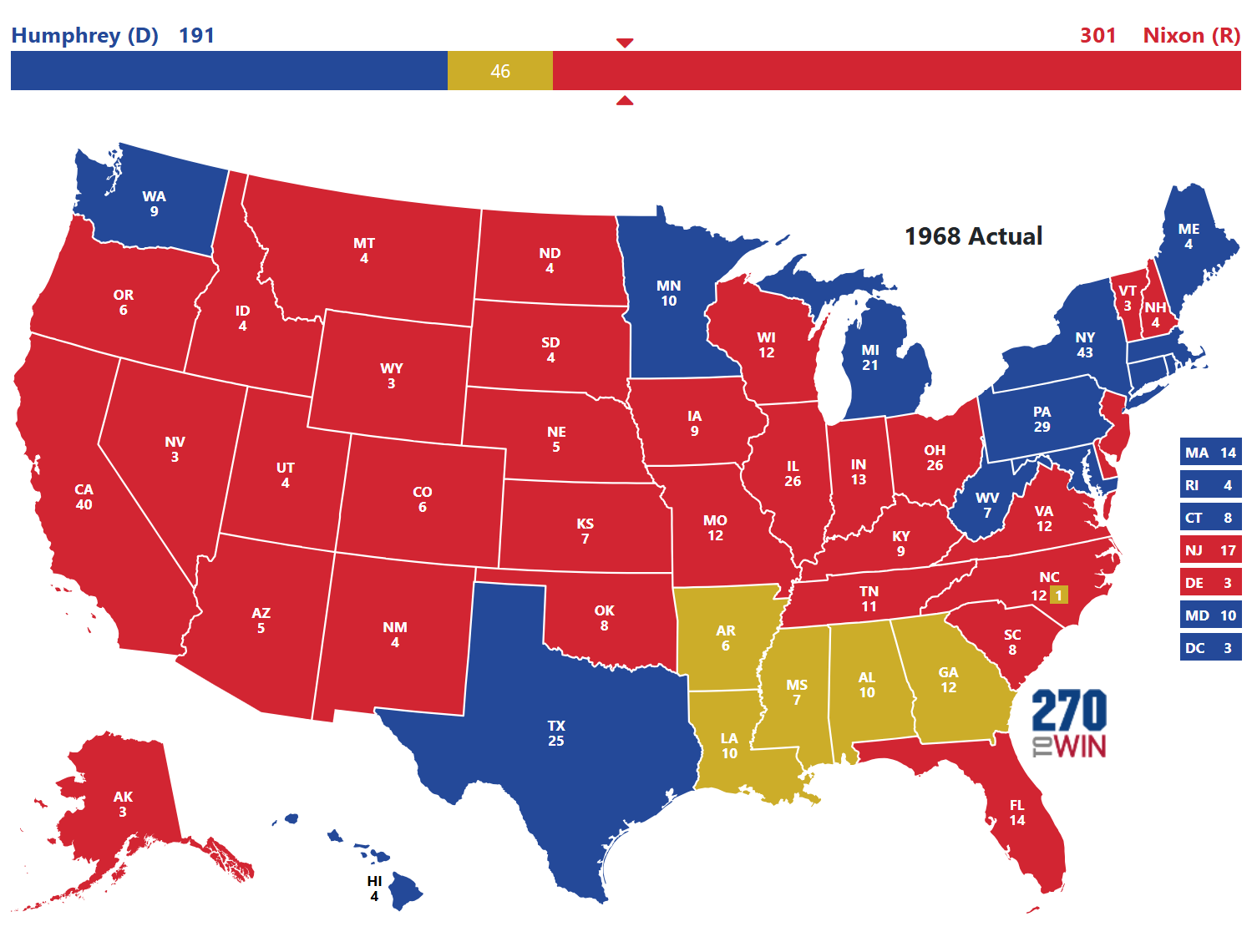
Electoral Map

Image result for 1968 electoral map


Vote by groups (enlarged view)
The HOUSE VOTED TO ABOLISH THE ELECTORAL COLLEGE
Nixon supported the idea.  Repeat, Nixon supported it.
No one subject more profoundly involves the issue of popular sovereignty than the method of electing the President. For almost two centuries the system of the Electoral College has somehow worked, albeit just barely at times, and at other times even doubtfully. Every four years the American democracy places a large, unacceptable, and unnecessary wager that it will work one more time, that somehow an institution that never in any event functioned the way the framers of the Constitution anticipated, will somehow confer the Presidency on that candidate who obtains the largest number of votes. The Electoral College need not do so. Indeed on occasion it has not done so. But far more importantly--whatever the popular vote--it need not confer the Presidency on any candidate, if none has a majority of the electoral vote.
Our ability to change this system in time for the 1972 elections is a touchstone of the impulse to reform in America today. It will be the measure of our ability to avert calamity by anticipating it.
As I stated in my October 1969 message, I originally favored other methods of reforming the electoral college system, but the passage by the House of a direct popular election plan indicated that this thoroughly acceptable reform could be achieved, and I accordingly supported it. Unfortunately, the Senate has not completed action. Time is running out. But it is still possible to pass the measure and to amend the Constitution in time for the 1972 elections.

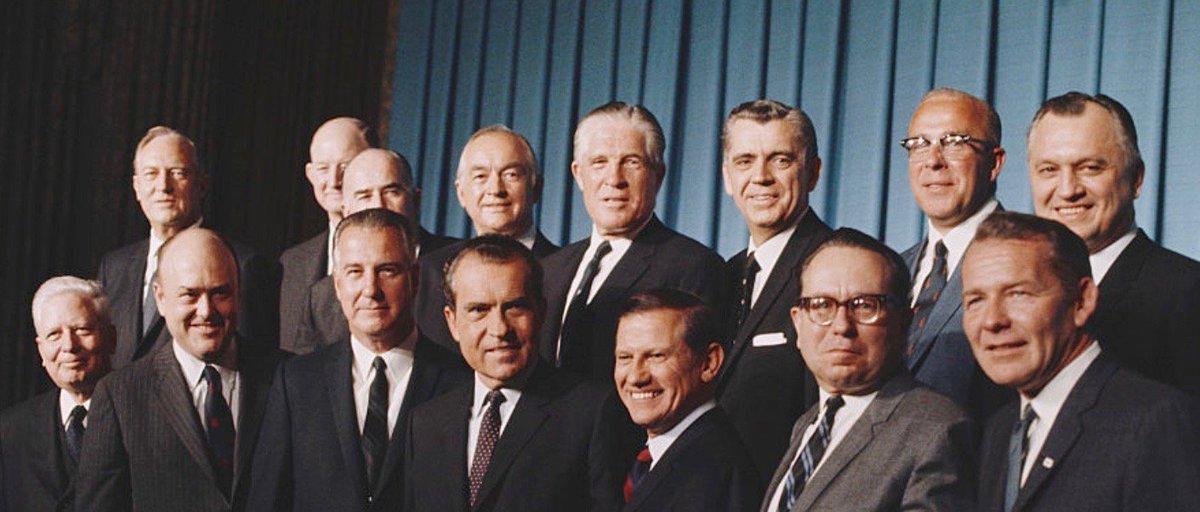
Nixon cabinet

Notice something about the demographics?


Image result for nixon cabinet 1968


Tuesday, March 2, 2021

The Fall of 1968

For next time, Nelson, ch. 8.

Review from last time: Why Agnew?  

  • THURMOND HAD VETO 
  • Contrast with Lodge
  • Bailed from Rocky
  • Again: Attacked civil rights leaders  (and see who was mayor of Baltimore)
  • MD:  Slave state that was in the Union
  • No vetting.  He was taking bribes.  Mitchell probably knew.
  • Gaffe machine -- quickly discredits self.  From his 1996 obituary:
  • The nine-week election campaign did little to polish Mr. Agnew's image, marked as it was by a series of gaffes. He spoke of ''Polacks,'' and of a ''fat Jap''; he accused Vice President Hubert H. Humphrey, the Democratic candidate, of being ''soft on Communism,'' a comment that drew rebukes even from fellow Republicans. Although billed as the Nixon camp's urban expert, Mr. Agnew disdained visits to ghettos, saying, ''If you've seen one slum, you've seen them all.''

 Lessons from 1960:

  • Management
  • Schedule
  • Media
  • Debates

HHH

Disadvantages

  • Convention
  • Hawks v. Doves
Advantages

Wallace

  • Inaugural address
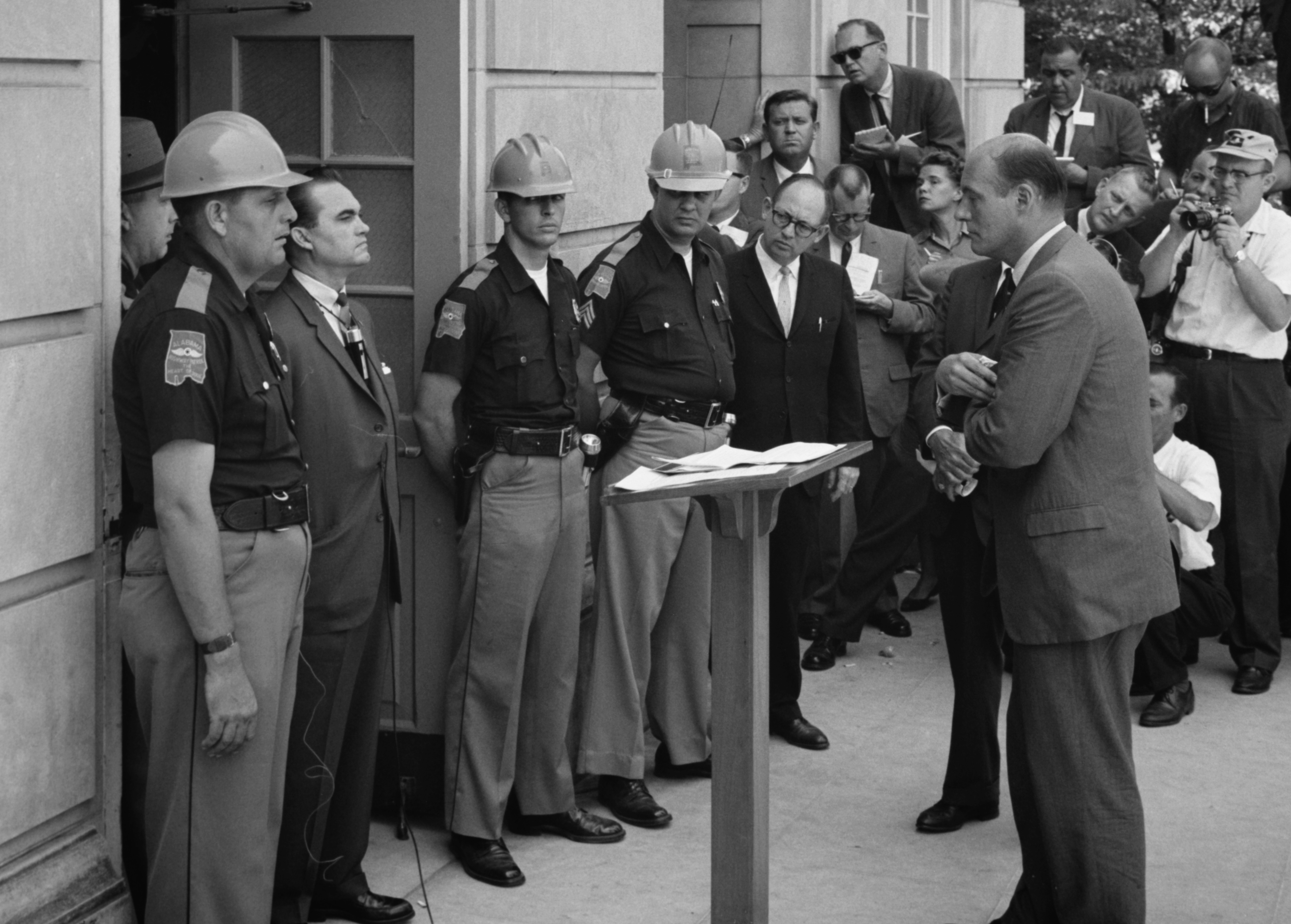
  • In 1963, literally stood in the schoolhouse door.
  • Strong at first, leaks support to Humphrey
  •  LeMay (Nelson 206)
  • In 1968, David Broder wrote of George Wallace:
    • What strikes you about that message — and I am trying to be as restrained as possible— is its steady and repetitive incitement to violence. Wallace may not be tougher on law and order than Nixon or Humphrey, but he verbalizes the wish to lash out against those who offend in a way that more restrained and responsible leaders would never do in an age of violence such as we live in...If any anarchist (the Wallace word for "demonstrator") lies down in front of a Wallace motorcade, "it will be the last car he ever lies down in front of."  If students fly the Viet Cong flag in a Wallace administration, "I would have me an Attorney General that would drag them in by their long hair and ..." You rarely hear the last words of Wallace's threats, because they are lost in the roar from his crowd. "Crowd" is perhaps too polite a word. When Wallace has finished his harangue, the emotion is closer to that of a lynch mob -- a pack of angry, frustrated men and women, who see his cause, not just as a chance for victory but as a guarantee of vengeance against all who have affronted them for so long.

 Vietnam

Why does Humphrey close?

Gallup